Wednesday, September 25, 2013
Interview with Mark H. Kruger, author of young adult thriller, Overpowered #YA
Saturday, September 21, 2013
Happy Birthday Mr. Wells - A SciFi Original #SciFi #classic
by Lynnette Phillips
Like many readers my first experience with Mr. Wells was at the movies but what an introduction it was. His books filled the library shelves which is the first place we'd run to after seeing the cinematic version of one of his books. Even though he wrote in several different genres his 19th century science fiction is still enjoyed over 100 years later.
Monday, November 7, 2011
Bestselling Author Sarah Dressen Talks About Her Novel What Happened to Goodbye #YA
New York Times bestselling author Sarah Dessen dishes details on her upcoming novel, WHAT HAPPENED TO GOODBYE.
Since her parents' bitter divorce, McLean and her dad, a restaurant consultant, have been on the move-four towns in two years. Estranged from her mother and her mother's new family, McLean has followed her dad in leaving the unhappy past behind. And each new place gives her a chance to try out a new persona: from cheerleader to drama diva. But now, for the first time, McLean discovers a desire to stay in one place and just be herself, whoever that is. Perhaps Dave, the guy next door, can help her find out.
Friday, September 30, 2011
Great British Authors of Children's Books By Carolyn Clayton
There are not many authors who can write compelling stories that both adults and children can both love. John Boyne, who wrote 'The Boy in Striped Pyjamas' is one such author. He says himself that it's not a matter of writing books for children that adults will like; it is all about good story telling. John Boyne did a degree in literature at Trinity College in Dublin after which he took and year out and then went on the Malcolm Bradbury's creative writing course at the University of East Anglia. Here he won the Curtis Brown award and never looked back.
Another great children's and adult author is Roald Dahl who was born in Cardiff in 1916. He didn't get much praise for his writing and was even told by his English teach he would never succeed in writing. This put him off going to university. After a stint in the Royal Air Force he rose to fame in the 1940's and went on to become one of the world's bestselling authors. In 2008 the Times places Dahl sixteenth in its lit of 'The 50 great British Writers since 1945'. His books are known for their un-expecting and surprising endings, often using very dark humor. He worked at Cadbury the chocolate company which is where he got his inspiration for writing Charlie and the Chocolate Factory which he wrote in 1964 and made in a film 1971 but renamed Willy Wonka and the Chocolate factory. Apparently he dreamed of inventing a new chocolate which would impress Mr Cadbury himself. Instead he used his imagination to create the famous chocolatier and factory. Matilida was his most successful book which sold over half a million copies in 6 months, capturing hearts of many children and adults alike. Like most of his bestselling books Matilda was made into an award winning film.
JK Rowling is probably the most recent author of childrens and adults books who is on everyone's radar thanks to the great success of the Harry Potter Series. She has won numerous awards including an OBE in 2001, in 2010 was voted the most influential women in the UK by leading magazine editors. According to the Sunday Times Rich List J K Rowling is now worth an estimated �530million. Joanne Rowling which is her real name is also just as famous for her 'rags to riches' life story. She went from living on benefits as a single mum to become a multi millionaire within 5 years.
The Harry Potter books are a great example of stories that appeal to people of all ages. From the research I did for this article I found out some useful tips on writing great children's and adult stories. For a start you shouldn't write for a specific age group, just write your book and let its market find it. Build a believable world and write about universal themes. J K Rowling does this cleverly in the Harry Potter series. She manages to incorporate the classic causes of bullying, racism, snobbery and jealousy into her magical world of Hogwarts. This gives readers a chance to identify the characters regardless of the actual setting.
For more information on going on a [http://britmovietours.com/bookings/harry-potter-walk/]Harry Potter Walk or the popular [http://britmovietours.com/bookings/harry-potter-london-tour]Harry Potter London Tour why not check out Brit Movie Tours who are a London based tour company offering many other London film Locations tours.
Article Source: [http://EzineArticles.com/?Great-British-Authors-of-Childrens-Books&id=6570710] Great British Authors of Children's Books
Monday, September 5, 2011
Humor Author Alanna Parke Kvale Reaches Out With Her New Book ~ Widowhood Is Not Funny
When it comes to writing, you always hear, “write what you know, write from your own experiences.” For many years, I did just that, and tried to find the humorous side to everything-marriage, kids, everyday life-no problem.
I’ve written about the internet, video games, car repairs and couch potatoes. I even found the funny side to one of my passions-crochet. I wrote about being a Craft Junkie.
The last few years however, it’s been impossible to find the humorous side to my present circumstances. In February of 2004, I lost my husband to a sudden heart attack, and so became, in a heartbeat, a widow.
I looked carefully at every angle, searching for any clue to humor in the subject, but there’s nothing there. Widowhood is simply not funny. What I did learn is that Life is funny, sometimes even hilarious, rib-tickling, side-splitting, knee-slapping funny. But Death is not, no way, never going to happen, simple as that.
However, a good writer writes about everything that she experiences. I’ve journaled for decades and this period in my life was no exception, though it has been painful to record. I told myself that writing about this experience was necessary for me, as well as for others. No one can avoid the loss of loved ones forever.
It took three years before I found the courage and strength to sit down and put it into words; it hurt too damn much. The sadness would overpower me and I’d push it away, unable to face the pain. I worked on the book for a year, all the while dealing with depression, anger and fear.
Whether that little voice that kept admonishing me to finish the book was God speaking to me, or a really impatient Muse, I don’t know. Nevertheless, Widowhood Is Not Funny is now finished, published as an e-book and available for all e-readers or to read on your computer. It’s a guidebook for new widows and is intended to help them along this journey, past the grief and into a new future.
You can find Widowhood Is Not Funny at:
http://ebookstore.sony.com/ebook/alanna-kvale/widowhood-is-not-funny/_/R-400000000000000364250
You can also find me at:
http://www.widowhoodisnotfunny.blogspot.com
I hope you’ll leave me a post and tell me how you’re doing.
And you can also write to me at
Alanna Parke Kvale
Thank you Alanna for fighting through the pain and sharing with us,
Wednesday, August 3, 2011
Author Alex Adena Talks About Writing ‘Signs & Wonders’, being a “user of nom de plumes” and Alfred Hitchcock
Thank you for spending time with us and sharing some insights into the writing of ‘Signs & Wonders’. If you’re ready I guess we should jump right in.
Lynnette Phillips: What inspired this novella? Is this your writing debut?
Alex Adena: I’ve written for the stage as well as a few screenplays, but this is my first novella. “Signs and Wonders” actually started out as a screenplay. I wanted to write a story about the nature of faith and what happens when you begin to doubt everything you’ve been taught. This story takes that to an extreme – what happens when everything in your life has been a lie and you have to start over from scratch?
LP: Some authors have told me that they build their characters based on people they know. Is that how Annie Grace came to be? Or was there a formula you followed for character development? How did you come up with the characters in Signs and Wonders?
AA: Annie Grace isn’t based on a real-life person. The idea for her came when, out of curiosity, I watched a few minutes of Benny Hinn’s program. That’s when the idea came to me: What if a faith healer –- one who knew their act was a complete con – discovered they really COULD heal people? I knew my faith healer would be a woman because it’s an area dominated by men and I wanted to explore something new. So once I had this strong Texas woman, I thought it would be interesting to pair her up with a slightly older Latino man. Not as a love interest, but as a substitute father figure. That’s how Ernesto came to be. I did have a few actors and actresses in the back of my mind as I wrote some of the minor characters, which is a trick a lot of writers use.
LP: Do you maintain a writing schedule? When you pick up the pen do the ideas just seem to flow?
AA: A lot of my writing during the past few years has been done during furloughs from work. We would have to take a week off, unpaid, so I would stay home and write. That’s how “Signs and Wonders” got its start this spring – probably half of it was written during that furlough week. After that, I set a goal to write at least an hour every day until it was completed.
LP: Do you have a favorite genre or style (short stories for example) that you you feel more comfortable writing?
AA: I’m definitely more comfortable writing novellas or short novels as opposed to epics. I’m never going to write 800 pages. I’d get bored and I think the reader would get bored. Until “Signs and Wonders” came along, I wrote material that was pretty edgy. But, you know, there’s a lot to be said for writing something that you can show your mother! Good stories can be told without a single word of profanity. My next book will be a sequel to “Signs and Wonders” and then I plan to write a family friendly romantic comedy.
LP: Is there a particular genre, maybe mystery or a who-dun-it,that you would like to try your hand at writing?
AA: Someday I’d like to give science fiction a shot, something in the style of Philip K. Dick.
LP: You claim to be a “user of nom de plumes”…why is that? When do you use them?
AA: Authors have to market themselves these days, especially if they self-publish, so I wanted a pen name that was Google-friendly. My birth name (Jeffrey Bruner) is also the name of a college professor in West Virginia, so I created Alex Adena. Search for Alex and the only thing that pops up is my blog and Facebook page.
LP: As an aficionado of Alfred Hitchcock do you have a favorite Hitchcock movie? Do you watch old reruns of his television show? (Even when I was very young I loved the way he could supply us with an off-the-wall mystery every week and have the culprit dealt [not always by traditional punishment measures] with in so short a time.)
AA: I never got into the television show, but I’ve seen all of his films. My favorite is definitely “Rear Window,” with Jimmy Stewart and Grace Kelly. The dialogue really crackles and the filmmaking, the technical side of things, is extraordinary. I never tire of seeing the scene known as “The Kiss,” when the characters meet for the first time. Hitchcock also created such an extensive body of work that a lot of films get overlooked. “Shadow of a Doubt,” with Teresa Wright and Joseph Cotten, is a real masterpiece about good and evil, all set in a quaint California town. It’s definitely worth watching if you’ve never seen it.
Thank you Alex…”Rear Window” is one of my favorites too; Raymond Burr was great as the husband. I’m going to have to take another look at “Shadow of a Doubt” though; I guess it’s been too long since I watched it. I don’t have a lot of memories of movie except that Teresa Wright was very young.
See the review of ‘Signs & Wonders’ now available on Amazon.com
Email: adena.alex@yahoo.com
Twitter: @alexadena
Facebook: www.facebook.com/authoralex
Saturday, July 23, 2011
Author Ivory Simone Talks About Her Novel ‘Havasu Means Blue Water’, Living in Bangkok and the “legacy of injustice”
Lynnette Phillips - What inspired you to write Havasu Means Blue Water?
Ivory Simone - My family history. I grew up listening to my grandfather who told me stories about his grandfather--a black Indian who came out of slavery as a boy. I found a 1780s census record with my great-great-grandfather's name and background information. The record confirms my grandfather's oral history was correct. This family history took on new meaning when I worked for a Native American Tribe years later. Both of these invents laid the foundation for Havasu Means Blue Water.
LP - Does "havasu" mean blue water?
IS - Yes, it does. In the Mojave language it means "blue water". One of the characters in the story is a descendant of a Mojave tribe decimated by disease and other anti-Indian government policies.
LP --Why should readers buy your book?
IS -- It's a snapshot of the cultural wars we see in the Southwest--in places like my home state of Arizona. The inhabitants of the fictional town of Wilburn, Arizona are threatened by outsiders. They have a history of crushing groups who are different. However, the violence unleashed against outsiders is also used against the women and children of the town. Hate is a monster that's never satisfied. When it runs out of enemies to eat, it'll start devouring its own. Havasu Means Blue Water is a cautionary tale about the price a society pays for remaining passive in the face of racial and cultural intolerance.
LP -- "The legacy of injustice" will be the topic in two author facebook chats that'll be held on July 10th and July 16th at 3:00 p.m. (EST). Why is this an important issue?
IS - I want people to think about what happens to a community when a grave injustice is allowed to fester. I want people to talk about what they can do to promote the healing of any festering wounds of injustice that divide and weaken their own communities. Justice is not optional--it's essential to the well-being of a community and its people.
LP -- The love between the two murdered victims, Mary Alice and Nathaniel Venerable, is central to the novel, why?
IS -- I believe love is the greatest force on earth. It's far greater than hate, far greater than the tyranny of violence. We first meet Mary Alice and Nathaniel as victims. However, I want readers to remember them for the deep love they shared. It's their love story that reaches out from the grave to influence the living, to propel events that bring about change.
LP -- Mother-daughter relationships are also explored quite a bit in the novel. The relationship between Lyla Amir, the heroine of the story and her mother and the relationship between Amber Goody and Bonnie Good, a dysfunctional daughter and mother--are both important threads in the plot. Why?
IS -- I'm a daughter and a mother of daughters. A daughter's relationship with her mother helps determine the type of women she'll grow-up to be. I wanted to show how certain acts and omissions mothers/women make in their lives shape the women their daughters become.
LP -- Lyla Amir is an unusual heroine. She's an Arab-American of mixed parentage (her mother is African-American) investigating the murder of a black farmer and his wife. Her heritage is one of the story lines that adds tension to events that unfold in the novel. Why did you make her Arab-American.
IS -- Lyla Amir's heritage is important because I believe Arab Americans now understand what Black Americans already know--what it feels like to be an undesireable "other". Lyla self-identifies as black but she has racially ambiguous features. This presents problems for her when she goes to Wilburn. It's her Arab heritage that becomes the source of hatred and conflict for her.
LP - The question of identity is also one of the issues Firestone Matise, the descendant of Mary Alice and Nathaniel Venerable, faces, too. Why?
IS -- I think people are quick to label others based on appearance alone. I wanted to challenge the notion we can know a person's history based on his or her racial profile. Racial stereotypes get in the way of Americans' ability to form positive relationships with one another. The browning of America will make such thinking a liability in the future. I believe that's a good thing in the long run
LP -- What do you want readers to know about Ivory Simone?
IS - I'm a writer and poet who dreams a lot. I have a vivid and active dream life that makes my journey in the world fascinating and sometimes strange.
LP -- What's it like living in Bangkok, Thailand?
IS -- There's never a dull moment. More importantly, I'm able to move about in relative safety and ease.
To read my review of ‘Havasu Means Blue Water’ and more about Ivory Simone follow this link.
See the Ebook Trailer for ‘Havasu Means Blue Water’
Thank you Ivory for talking with us and for your wonderful novel ‘Havasu Means Blue Water’
Lynnette Phillips
Thursday, July 7, 2011
Monday Is One Day by Arthur A. Levine #kidlit
Friday, June 10, 2011
Matthew Kirby, Author of THE CLOCKWORK THREE ~ #MG
Matthew J. Kirby discusses THE CLOCKWORK THREE--his brilliant debut novel about three children, an enchanted green violin, and an automaton come to life.
Tuesday, May 31, 2011
Vonnegut Advice: Short Stories
Saturday, May 21, 2011
Eva’s Doubloon by Tim Summa - #Book Trailer~Experience the Adventure
Author Tim Summa Talks About Eva’s Doubloon, Shipwrecks, Diving, Rare Coins and a Possible Sequel
Eva's Doubloon is best described as a thriller, though it starts out as a mystery, ends as an adventure, and has an element of fantasy in between. Of course, its underlying romance evolves from beginning to end. When the manuscript was approved to be published, the woman with Outskirts Publishing that approved it told me the story read like a movie in her mind. That made me feel good about the writing, because as it was being written, that's exactly how I saw it.
Tuesday, May 17, 2011
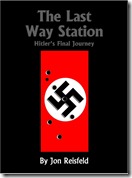
Guest Blog by Jon Reisfeld -- The Story Behind 'The Last Way Station: Hitler's Final Journey'
Thirteen years ago, when I first seriously entertained the idea of writing fiction, I found myself obsessing on a rather strange, and unpleasant, topic. I became preoccupied with the question of Adolf Hitler and his special brand of evil. Most Jews, who noodle on the subject of der Fรผhrer for any length of time, end up framing their questions about his rise to power and his essential role in the realization of the holocaust, in the form of an accusation. They point their index fingers at the Almighty, and ask, "How could you let this happen?"
I had no interest in diving down that rabbit hole. In the first place, Hitler and the holocaust did happen. Whether God 'let it happen' or not seemed completely beside the point. In my mind, that line of inquiry epitomized the type of thorny, arcane and largely non-essential question that theologians love to debate. After all, hadn't they spent the entire Middle Ages arguing about how many angels could comfortably fit on the head of a pin?
What I wanted to know was what, if anything, could possibly constitute 'fitting punishment' for someone as innately and actively evil as Hitler. What form would it take? While his death, by any means, might bring some immediate satisfaction to his victims, how could the exchange of Hitler's one life ever begin to atone for the loss of the millions of innocent lives he had taken? It's the same question millions of people, around the world, asked themselves, following the recent death of Al Qaeda leader, Osama bin Laden.
Moreover, Hitler's suicide deprived the world of a chance to try and judge him for his crimes. That's when the idea hit me: I could write a story about Hitler's final judgment, in the afterlife. Several benefits of this approach immediately presented themselves. The supernatural beings who rule the afterlife would share God's omniscience and, therefore, know all of Hitler's crimes in advance. Hitler would not be able to lie his way out of trouble. They could see right through him. That would not only save a lot of time in developing the story, it also would deprive Hitler's character of yet another platform to exploit, in putting forth, and promoting, his sick, twisted agenda of hate.
All that remained for me was to research the subject and begin drawing on my imagination. Those tasks still managed to produce some uncomfortable moments, such as when I purchased Mein Kampf, at the local bookstore. (The book remains off limits to readers in Germany, today.) Then, there were all those equally awkward nights at home, when my son and my ex-wife watched TV while I, a nice Jewish dad, sat nearby, engrossed in Hitler's memoir or poring over such books as Explaining Hitler.
The final version of the book is shorter than originally intended, and I actually took more than a year off from writing it (when I was halfway through), because parts of it were so disturbing to me. I'll be happy to discuss these issues and more with you, once you've had a chance to read it.
Author Bio: I am a single, Baltimore, MD - based writer, marketer, former journalist, and father of one, who has eclectic interests, a passion for social justice and an insatiable thirst for good science fiction. After you read my books, please drop me a line and let me know what you think of them. I look forward to it.
Read an excerpt from ‘The Last Way Station’
Get a Free Download of this book from Smashwords Using the code PA54X at checkout.Please feel free to leave a review at Smashwords &/or Amazon
Friday, May 13, 2011
Guest Blogger, Steve Chicoine, Author of BUZZ, Talks About His Captivating New #YoungAdult Novel
A beekeeper I met in a rural Texas cafรฉ long ago was the inspiration for BUZZ. I pitched a nonfiction book with photos on this man’s existence to a publisher with whom I had previously worked. They did not jump on the project and another publisher diverted my attention by responding to another book proposal. Later, while outlining a thriller set in South Texas, my story evolved in a series of major changes into BUZZ, a coming-of-age story which transports the reader to the mesquite brush country. The many drafts over several years allowed me to layer the story into the rich narrative that it is today.
In BUZZ, a young man's search for personal identity collides with an examination of personal responsibility for the environment and systemic racism. There is serious scientific concern as to the disappearance of the bees, known as Colony Collapse Disorder (CCD). At the same time, Matt’s more immediate concerns involve his relationship with Maria, the harassment of the ranchers’ sons and the treacherous creatures in the brush, both man and beast.
Book Synopsis:
BUZZ opens on the mean streets of Chicago with Matt making a bad decision that has dire consequences. His mom in desperation sends him to his aunt’s in South Texas for the summer. Matt is determined to somehow get back home to Chicago. That is even before he encounters the local bullies, who are relentless in harassing him. Matt’s chance encounter with Maria seems to brighten the possibilities for the summer, but their intense relationship leads to far more challenges than he could imagine.
An old beekeeper, named Buzz, befriends Matt. He hires Matt to help him out so Matt can save the money for a bus ticket home. Buzz teaches Matt about beekeeping, but he also exposes Matt to the country way of life, the flora and fauna of the mesquite brush country, the dire situation of the bees and much more.
Matt realizes that his life on the streets of Chicago offers little hope and that his mom’s relationship with her latest boyfriend is a disaster. He learns that sometimes the best family is the one you choose. The rising tension that leads to the climax forces Matt to make difficult choices on terms that are not of his choosing.
Author Bio:
Prior to BUZZ, Steve Chicoine published eight books with major houses. His author’s website is www.freedomhistory.com. The website also includes many of his photographs from his adventure travels around the world.
BUZZ is available in paperback and in e-book formats through www.indigotreepublishing.com.
Don’t miss an excerpt from ‘BUZZ’ on this site tomorrow!
Thursday, May 12, 2011
Guest Blogger, Steve Chicoine, Author of BUZZ, Talks About His Captivating New #YoungAdult Novel
A beekeeper I met in a rural Texas cafรฉ long ago was the inspiration for BUZZ. I pitched a nonfiction book with photos on this man’s existence to a publisher with whom I had previously worked. They did not jump on the project and another publisher diverted my attention by responding to another book proposal. Later, while outlining a thriller set in South Texas, my story evolved in a series of major changes into BUZZ, a coming-of-age story which transports the reader to the mesquite brush country. The many drafts over several years allowed me to layer the story into the rich narrative that it is today.
In BUZZ, a young man's search for personal identity collides with an examination of personal responsibility for the environment and systemic racism. There is serious scientific concern as to the disappearance of the bees, known as Colony Collapse Disorder (CCD). At the same time, Matt’s more immediate concerns involve his relationship with Maria, the harassment of the ranchers’ sons and the treacherous creatures in the brush, both man and beast.
Book Synopsis:
BUZZ opens on the mean streets of Chicago with Matt making a bad decision that has dire consequences. His mom in desperation sends him to his aunt’s in South Texas for the summer. Matt is determined to somehow get back home to Chicago. That is even before he encounters the local bullies, who are relentless in harassing him. Matt’s chance encounter with Maria seems to brighten the possibilities for the summer, but their intense relationship leads to far more challenges than he could imagine.
An old beekeeper, named Buzz, befriends Matt. He hires Matt to help him out so Matt can save the money for a bus ticket home. Buzz teaches Matt about beekeeping, but he also exposes Matt to the country way of life, the flora and fauna of the mesquite brush country, the dire situation of the bees and much more.
Matt realizes that his life on the streets of Chicago offers little hope and that his mom’s relationship with her latest boyfriend is a disaster. He learns that sometimes the best family is the one you choose. The rising tension that leads to the climax forces Matt to make difficult choices on terms that are not of his choosing.
Author Bio:
Prior to BUZZ, Steve Chicoine published eight books with major houses. His author’s website is www.freedomhistory.com. The website also includes many of his photographs from his adventure travels around the world.
BUZZ is available in paperback and in e-book formats through www.indigotreepublishing.com.
Don’t miss an excerpt from ‘BUZZ’ on this site tomorrow!
Tuesday, May 3, 2011
30 Going on 13 Grown Up Girls Come Out of the #YA Book Closet By Sarah Ockler, Author of Twenty Boy Summer #YAlit
There's so much to love about modern young adult (YA) fiction. It's deep and sophisticated. It's edgy, exciting, and heartbreaking. It' swell written. And as any teen reader will attest, it's down right entertaining.
But teens aren't the only ones indulging their literary taste buds in this growing genre. Adult readers account for much of YA's explosive success, and thanks in part to the crossover appeal of blockbusters like Harry Potter and Twilight, YA publishers and booksellers have embraced adult readers, making it officially okay for us to show some YA PDA.
YALit: Seven Reasons to Swoon
Young adult fiction is typically written with teen readers in mind, but adult fans love the genre for the same reasons:
1. YA lit brings us to a time of heightened emotion. I laughed. I cried. I told off my parents, slammed my door, and broke stuff. Think back before the mortgage or rent, before the office, before the kids. Remember when every action and feeling was a million times intensified and each decision was one of life-or-death? Great YA authors remember, too,reliving those times in vivid detail on each page through complex teen characters and real-life struggles that our hearts, minds, and bodies can relate to.
2. We never really get over that first love. Butter flies in your stomach. Heart banging wildly against your ribs. The forbidden taste of that stolen kiss. Whether you look back on your first love with affection, longing, laughter, embarrassment, or relief, young adult books have the power to reach right in and give your heart a squeeze, just like those first times from so long ago.
3. YA books are digestible. Teen reads tend to be faster reads, written with tight prose that drives the plot and character development without a lot of naval-gazing. The best YA books call forth and use that sense of heightened emotion rather than heavy internal monologue to propel us through the story.This isn't to say YA lit is light and fluffy -- it just packs more punch into fewer pages.
4. YA romance is sexy, not smutty. Well written teen love scenes showcase romance, depth, and -- depending on the story -- sex, in all its forms. But readers won't stumble on to anything throbbing, heaving, or sinewy in a YA story, making teen fiction a great choice for women looking for romantic reads sans the sweaty details.
5. YA spans the shelves with diverse sub-genres.Young adult lit encompasses romance, horror, fantasy, mystery,historical, gay/bi/transgender, sports, chick lit, verse,contemporary, and lots of mix-and-match combinations. No matter which categories classify your faves, the teen section is sure to have a title to please.
6. YA doesn't fear hard issues. The current crop of young adult literature tackles tough topics head on.Whether the story is fantasy or contemporary, romance or mystery, YA characters deal with rape, drug abuse, death and grieving, love,suicide, genocide, street crime, racism, classism, politics, sex and sexuality, parental struggles, body image, and even the occasional vampire-human-werewolf love triangle.
7. YA authors write to compete. Writing for teens is a fierce competition -- not against other YA authors, but against other forms of entertainment. Teens today are a highly discerning and opinionated audience in an era where word-of-mouth spreads in nanoseconds and the next best thing is just one click away. In a sea of teen titles and ever-changing forms of attention-grabbing media, YA authors work hard to craft compelling books that can earn and keep the adoration of young readers.
YA Online: Where to Look For Top Teen Books
With no signs of stopping, young adult fiction continues to grow and diversify, invading the social network scene through book sites and movie-like trailers, online book clubs, teen review blogs, author chats, and hundreds of interactive features that marry books and technology for promotion, education, and fun. Armed with an Internet connection and a Web browser, readers can find lots of places to show a little YA love and discover great new reads:
- 2009 Debutantes - an online community of young adult and middle grade authors making their publishing debuts in 2009. The site includes the debut book list with descriptions, author contact information, and general discussions about YA literature and writing.http://feastofawesome.com
- Goodreads - a book-focused social network site where members rate and review books, make recommendations, start discussions,and "shelve" books by genre and keywords. The Goodreads YA shelf is a great place to find recent reviews and comparable titles.http://www.goodreads.com/shelf/show/young-adult
- Indie Bound Kids' Next List - a list of recommended reads for teens, hand-picked by independent booksellers all over the country.Check out their recommendations and search online for titles at the indies in your area. http://www.indiebound.org/kids-indie-next-list
- Amazon.com > Teens > Books - Amazon.com's teen section showcases new and upcoming teen reads, including award-winners and seasonal best sellers. You can also search for YA books within specific sub-genres like mysteries, series, historical fiction, and more. http://amazon.com
- YALSA Book Awards & Booklists - the Young Adult Library Services Association of the American Library Association features teen books that have won awards and accolades from literary associations and other professional groups. Categories include the Michael L. Printz Award, Best Books for Young Adults, Teens' Top Ten,and more. http://www.ala.org/yalsa/booklists
- Twilight Moms - includes an ongoing discussion of Stephanie Meyer's Twilight books and movies, related book recommendations, shopping links, charity support, interviews, forums,and friendly online connections for women who love Twilight and other teen books. http://www.twilightmoms.com
- My Favorite Author - a YA book blog by three adult women who love to read young adult fiction. Features book reviews, author interviews, contests and giveaways, and relevant commentary about current YA book trends and topics. http://myfavoriteauthor.blogspot.com
Reluctant YA Readers: Come Out, Come Out, Wherever You Are!
Today's teen book selection is dazzlingly diverse, easily accessible, and wallet-friendly -- most hardcover YA titles sell for about ten dollars less than their adult counterparts. So the next time you're caught reading teen lit with the book covers down, don't explain away your affair with YA or apologize for your youthful taste in literature.Take the opportunity to introduce your companions to the richly entertaining YA community. Tell them what you love about the genre.Make a few personalized recommendations. Maybe even start a YA book club to discuss your favorites.
Together with booksellers, librarians, publishers, authors, and the millions of savvy teen readers devouring and defining this exciting genre, we can embrace our love of young adult fiction -- loud, proud, and post-prom PDA-style.
Happy reading!
©2009 Sarah Ockler, author of Twenty Boy Summer
Author Bio
Sarah Ockler, author of Twenty Boy Summer, wrote and illustrated her first book at age six-an adaptation of Steven Spielberg's E.T. Still recovering from her own adolescence, Sarah now writes for young adults. While nomadic at heart,she currently lives in Upstate New York with her husband Alex and an ever-expanding collection of sea glass.
Visit her online at www.SarahOckler.com
Source: FSB Media
Saturday, April 30, 2011
Author, Terry Persun discusses his post Civil War novel, “Sweet Song” about a mulatto who passes for white.
“Sweet Song” is my fifth novel and you’d think that I’d be used to researching by now. Plus this one was supposed to be easier since I grew up in and around Williamsport, where much of the novel takes place. For example, I’ve hiked many of the Indian paths and logging roads in the area. And, you don’t have to look too hard and you find living quarters where “the help” stayed while caring for the stables or cooking for the farm-owners. Even though a lot of those buildings were eventually torn down or converted into chicken coops or work sheds.
Of course I visited a lot of local museums and libraries looking for evidence of slavery in Pennsylvania, regardless of the fact that Williamsport was a landing place and safe haven for the Undergroud Railroad. I collected dozens of books about the Susquahanna River and its history. I also bought a few specific texts from Writers Digest Books like “Everyday Life in the 1800s,” “Everyday Life in the Wild West from 1840-1900,” and “Everyday Life Among the American Indians from 1800-1900.” And I used the Internet.
So, what was the real problem? Dialect. That’s something that’s difficult to find. There are no audio tapes of slaves and slave owners from that time period. So, my greatest fear was that I’d use some sort of dialect for black slaves that I picked up from television or the movies, which would sound completely false. I wanted the book to read authentically. I knew that whites didn’t speak any better than blacks in those days. Any slang came from cultural differences, not the language. Like jumping the broom means getting married. But slang isn’t dialect. Dialect has a certain sound of its own.
My decision, finally, was to use some very generic dialect based on education level. For example, some of the blacks and whites in the book speak the same. They clip the ends of “ing” words for instance. If someone is looking for a defined difference in speech in the book, they may find it, but it has nothing to do with race. I did however try to include turns in phrasing. I did this by picking up several books written by slaves about slavery, including a great little book titled, “Speak Out in Thunder Tones,” which is a group of letters and other writings by black Northerners from 1787-1865. The book was edited by Dorothy Sterling. Most mornings, before beginning my day’s writings, I read passages from that book to get me into the sound of the language, the rhythm and pacing. If there’s one book that got me through “Sweet Song” it was that book, and I am so grateful for its availability.
Terry has published five novels, two poetry collections, and a non-fiction book about the small press. His novel, “Wolf’s Rite,” was nominated as the fiction book of the year by ForeWord magazine. The novel also won the POW! Book of the Year Award and a Star of Washington Award. His novel, “Giver of Gifts,” was a finalist in the USA Book News Best Books of the year. Terry lives and writes on a small farm in Chimacum, WA.
Thank you for talk with us, Terry. You can visit Terry at his website www.TerryPersun.com and you can also hear a live interview with Brian Mercer at Author Magazine
Tuesday, April 26, 2011
Author Tim Summa Talks About Eva’s Doubloon, Shipwrecks, Diving & A Possible Sequel
How would you describe Eva’s Doubloon? (Fantasy, adventure…)
Eva’s Doubloon is best described as a thriller, though it starts out as a mystery, ends as an adventure, and has an element of fantasy in between. Of course, its underlying romance evolves from beginning to end. When the manuscript was approved to be published, the woman with Outskirts Publishing that approved it told me the story read like a movie in her mind. That made me feel good about the writing, because as it was being written, that’s exactly how I saw it.
Could you give your readers a brief synopsis of the book?
The book’s main character is Ethan, a widower with a growing internet business that he and his deceased wife had started. Before she died, they originally had plans to move near some friends in the Bahamas on a remote island they often vacationed at called Mayaguana. Before Maggie (his wife) dies, she encourages him to go on as planned. Seeking solitude to grieve the loss of his wife, he buys a strip of land on the southeast point, the most isolated and finds out he’s not alone. Mysterious women lying around in shallow water make him feel unwelcome with one actually sabotaging Ethan’s attempts to scuba dive. Finally attacked, Ethan’s reality is redefined as he finds out that mermaids are very much real. Running parallel to the story is a growing relationship between him and Mia, an abused woman seeking shelter after her boyfriend’s boat stops by the island. When a certain mermaid named Eva tries to make amends for the loss of his fishing boat, her compensation, a rare Brasher doubloon, ends up putting Ethan and Mia in even more danger. The story involves imperfect people, healing and second chances, all in a setting anyone would call paradise.
With the book being set in the Bahamas, I have to wonder if you have spent much time there? I know one of your passions is scuba diving. Have you spent any time exploring shipwrecks?
In the Bahamas on Andros Island is a Naval facility called AUTEC. As an aircrewman aboard the Seahawk helicopters, we would train there periodically in tracking and attacking simulated submarines. After our scheduled flights, the beach was ours. And because that part of the island was remote, the sea life is phenomenal. AUTEC is where I get most of my mental images for the scuba diving scenes in the story. I’ve dived around Florida, a little in Greece, and some in the Persian Gulf. Also in Missouri at Table Rock Lake and Bonne Terre, Missouri in an old underground lead mine (ranked number 10 out of 100 best dives in the U.S.). One of the best shipwrecks I ever dove was in the Persian Gulf, though. The friend I dove with had dive lights. While everyone else was around the wreck, we went in, down a long corridor, shining our lights into the dark rooms. The Persian Gulf surprised me. It was some of the most beautiful water I’ve ever dived in.
What inspired you to write this book--In other words what goals for this book did you have in mind when you took pen in hand, so to speak?
I really don’t consider myself a writer. Anyone that’s watched the Oscar’s lately can tell that Hollywood is running out of ideas. Especially with all the ‘remakes’. It was a slow couple of months at Redbox, plus my daughter playing with her ‘barbie-sized’ Ariel doll, and the lack of any stories out there like Eva’s Doubloon that finally got it done. But like I said, I’m not a writer, so it wasn’t until I started losing sleep over all these ideas hitting me that made me eventually sit down and start writing out chapter summaries. Surprised and having liked what I read, I teased myself into attempting chapter one. If I found that I couldn’t do it, I would be done with all of the nonsense. Four chapters later, the words just poured onto the monitor until my wife finally had to ask what I was doing. Because mermaid stories aren’t the most ‘manliest thing’ to write about, I was reluctant to tell her, but did. I think she laughed, until she read the first chapter. My objective was to make the story real – maybe even believable. The lady that approved the manuscript told me that, at first, she thought she was reading a memoir, complimenting my writing style. Until then, I didn’t even know I had one. Eva’s Doubloon is a story that is original. That’s what kept me awake at night until the plots and ideas were written down to later be incorporated into the story.
Did you do any research into shipwrecks or valuable coins while writing Eva’s Doubloon?
In writing the book, I chose Mayaguana as a setting due to it being so remote and sparsely populated. Spanish ships full of treasure really did sail past the island centuries ago, with it being the last sight of land before crossing the Atlantic. There really are rare Brasher doubloons, with the history I wrote in the book being accurate. Ephraim Brasher knew George Washington personally, and wanted his coin to be the first coin of the Republic. And, yes, one of the seven known Brasher doubloons really did sell for just under three million dollars. Lucayans really were the original natives to Mayaguana before Columbus discovered them and they were taken away as slaves. I learned several things about that part of the world that I wouldn’t have discovered if I didn’t write Eva’s Doubloon. The stories of mermaids go way back, all the way back to Alexander the Great, so there was obviously more there than just mistaken manatees. I’m definitely not the first sailor to deliver a mermaid tale, and I’m sure I won’t be the last. As someone who loves scuba diving, to write about any other mythical creature just wouldn’t seem right.
Do you have another novel in the works?
After finishing Eva’s Doubloon, having developed the characters, the book really introduces another world – one among our own, that’s hard to leave. Writing it was almost an escape – a vacation without having to leave home. A friend asked if I thought about doing a sequel. I reminded him that I’m not a writer. But afterwards, more ideas hit me and with the groundwork for the characters and setting already taken care of, the sequel is finished and on my computer. With it dove-tailing with the original story nicely, I like it even more, with more about the characters getting discovered. In the first book, Ethan is told that the mermaid’s treasure chamber in one of the caves is off limits. In the second book, with the cave being found by surveyors and divers going in regardless of Ethan’s warnings, Ethan insists on seeing what other divers died over, testing some of his own relationships in the process.
Tim, you make me wish I had learned to dive! Thank you for taking the time to talk with us.
Read my review of Eva’s Doubloon and look for Tim’s thriller, mystery, adventure, fantasy novel at Amazon.
Q & A by Lynnette Phillips, Avid Book Reviews
Saturday, April 23, 2011
Award Winning Author, Zohreh Ghahremani Talks About Her Novel Sky of Red Poppies and Her New Novel to be Released Later This Year
I so enjoyed Sky of Red Poppies. Reading it made me realize how much we’re missing by not hearing more from the hearts and minds of Persian immigrants. I was so impressed by the writing style and storytelling abilities it showcased.
Would you share a bit of your childhood with my readers…did your life resemble that of any of the characters in Sky of Red Poppies?
The house where Roya lived is my father’s house. The detailed descriptions are all true, down to the names of the servants. Roya’s life was indeed mine in the beginning – with the exception that I came from a larger family. To present Shireen’s true story as fiction gave me the poetic license to help Roya become who I always wanted to be! However, regardless of some added action to make the story flow, her emotions are absolutely true.
When did you first know you wanted to write?
I must have been born with a pen in my hand! Writing to me is what fresh air is to a runner. I can’t remember a time when I didn’t write and according to my teachers, I was put on this Earth to be a writer. Throughout my life, whether I studied, taught at the university, practiced dentistry or raised a family, I took every chance I had to write and when not writing, I dreamed of this day!
Have you had any inspirational teachers or writers in your life?
Many. I take pleasure in being inspired by others. As a young girl I was so impressionable that each time I came across a good book – and I was a heavy reader – I promised myself to someday be as good as that writer. I don’t know if that has changed at all for I still read a lot, learn from great writers and exchange imaginary notes with them!
Did you have a favorite character in Sky of Red Poppies?
One?! I love all of them, even the bad ones! Of course Shireen will forever have a special place in my heart, but how could I not love Pedar, auntie, Reza, Zahra and the rest?
I fell in love with the line of poetry that you quoted in a radio interview, "A word that comes from the heart, has no choice but to settle in another!" Do you find a lot of poetry relevant to life?
Indeed I do. I grew up in a society where poetry is part of life. Persians are really into poetry and in fact, much of our old literature is lyrical. We use poems in conversation, tell fortune from the book of Hafez and even play games that involve poetry. Whenever I feel lost for words, the verses I’ve memorized come to my rescue. This is not peculiar to me as most Persians seem to feel the same.
Will you give us a brief synopsis of your new novel, The Moon Daughter?
The Moon Daughter also comes from the depth of a woman’s heart. It is the story of a young wife, who aims to please her chauvinist husband. Unable to give him the son he wants, she faces great disappointment after each daughter is born. It is told in two parts. Part one, Rana’s Story, begins with the birth of her third child. Not only is this one a girl, she is also born with a problem. This is purely a Persian woman’s story.
Part two is Yalda’s Story, in which the daughter looks back at her mother’s past and seeks revenge. This part is seen and told from an American perspective.
Once again, the novel deals with current issues in Iran, but it probes the injustice that women in Iran as well as those in most of the Middle East encounter.
My editor is taking a final look at it and when I wrote to ask her what had caused a minor delay, she offered this explanation, “It's glorious, actually. So you could say I'm savoring it!” Let’s hope the readers feel the same when it comes out this fall.
Dear Lynette, I hope this has answered your questions and wish to thank you for your support. Furthermore, I thank your readers for their interest in the work of a new writer with an unpronounceable name! Should other questions come to mind, I will be happy to answer them and who knows? I hope we’ll meet someday.
BookReview: Sky of Red Poppies by Zohreh Ghahremani
Q&A by Lynnette Phillips, Avid Reader Book Reviews
Tuesday, April 12, 2011
Between Shades of Gray author video with Ruta Sepetys~#YA~A little Known Part of History - In 1941, fifteen-year-old Lina is preparing for art school, first dates, and all that summer has to offer. But one night, the Soviet secret police barge violently into her home, deporting her along with her mother and younger brother. They are being sent to Siberia. Lina's father has been separated from the family and sentenced to death in a prison camp. All is lost.
Thursday, March 31, 2011
Seven Rules for Writing Historical Fiction By Elizabeth Crook Author of The Night Journal: A Novel
We grow up being told to write what we know, but history is the unknown.You have to learn almost everything about a period and the social customs just to get your characters out of their beds, (or off of their skins,) and feed them breakfast.
Rule #1: Sweat the Small Stuff.
The authenticity of historical fiction depends on your knowledge and use of historical detail. It is not enough to say a character walked down the street. The reader has to be able to see the street, see the conveyances; he has to smell the smoke from the factories or the sewage in the gutter. If there are street vendors, he has to know what they reselling. This is a new world: the reader can’t fathom it unless you give him images. These should be accurate and not recycled from old movies.
Here are two suggestions apart from the usual methods of research.
1. Find experts on the topics you need to learn about. It’s easier to track down someone who knows about sheep ranching in the 1890s or the origins of the New York subway system, and to call them up when you need to know about scabies or the early methods of blasting tunnels,than it is to find, in documents or on the internet, the exact answer to every question that comes up in the course of writing a book. If you're going to write a scene involving a train wreck in 1891, get some books on train wrecks, read enough to know what you’re talking about, Google the authors and find out where they work. Call them up and see if they’ll talk to you. Latch on to the friendly ones. What about the couplers you can ask them, having read enough to know that faulty couplers were a major factor in train wrecks. If this is 1891, what kind of couplers would we have?รข€ I once needed to know about Mormons in Mexico. I Googled Mormons in Mexico, found a woman who had written a dissertation on a Mormon settlement near Juarez and tracked her down through the school. She spent two hours on the phone with me describing vividly the Mormon settlement that my characters needed to visit.Dozens of experts on a wide range of topics have generously helped me in similar ways.
2. If your story takes place after catalogs were in use, get hold of reprints of old catalogs. I have an 1895 Montgomery Ward Catalog that has descriptions of, and prices for, almost every personal item used by people of that time: hardware, books, stationery, toys, guns,toiletries, wallpaper, stoves, laundry equipment, harnesses and saddlery -- the list goes on and on. It represents the lifestyle of that decade.
Rule #2: Dump the Ballast.
In order to write authentic historical fiction you must know a period of time well enough to disappear daily through a wormhole to the past and arrive at the location of your story. There you must understand the customs and use the manners perfectly enough to be accepted by people walking the streets (if there are streets) and to dress yourself, and make a living. This said, the major trick of writing good historical fiction is not in compiling research or knowing the details, but in knowing the details to leave out. Try to avoid overwriting. Keep perspective on what will interest the reader. Historical fiction writers tend to be overly conscientious and excited by minutia: if you succumb to excess, and put in too much detail, then go back later and take some of it out. Think of your novel as a boat that is about to sink from having too much weight on board: some of the loved items will have to go. Toss them over with impunity! Throw them out! If a rare,surprising statistic, or a moving anecdote, or an obscure reference you saw to an interesting thing that happened in the county adjacent to the one where your story takes place, does not advance your plot or provide your reader with important information about your characters, then it is irrelevant to your story and must go overboard.
Keep in mind that the care, and time, it took to assemble all that you have just thrown out has not been wasted. It was necessary to gather these facts and assess their worth in order to know which ones to save.
Rule #3: Keep Your Conscience Clean.
If your characters are based on real people and you are using the names, be reasonably responsible to the originals. You are probably going to have to fill in a lot of gaps in the historical record: you may know from the record what a person did and when he did it, but not why. It’s the why that defines his character. Ask yourself: Am I getting this right? Am I getting it close to right? Am I doing this person a disservice?
Rule #4: Resist Judging Your Characters.
We live in the 21st century with certain shared values: our society disapproves of prejudice and chauvinism and provincialism. But your characters are people of their own times; allow them to be bigoted or politically backwards. Don’t pass judgment on them, don’t apologize for their mistakes, and don’t attempt to make them all into free thinkers who are ahead of their times. You have to be able to see the story from their perspective, even if it offends you. If you judge your characters, you will date your book. Years from now when your own moral sensibilities are antiquated, your book will be too.
Rule #5: Watch Out for First Person.
I put down three books recently because I was annoyed with the first person viewpoint, which came across as self-absorbed. Unless you’re writing in the form of letters or journals, make sure any first-person character has a good reason to be telling his story. People tend not to like people who notice themselves too much or describe themselves or seem overly aware of how others perceive them. Anyone relating a story about himself -- what he said, what he was wearing, what inflection he had in his voice or what gesture he made as he spoke some pronouncement-- we dismiss as annoying and self-important. We feel the same about characters. There are many beautiful books written in first person, but know the challenge of this before you start out, and be sure to give a credible reason why your character needs to tell his story and why he deserves an audience.
Rule #6: Don’t Get Bogged Down by Back-story.
It is easy to be overly dutiful and bore your readers with too much background information delivered too soon. There is no surer way to lose your reader than to answer every question before he wonders about it. Don’t explain everything up front or set things up too thoroughly.Instead, let your story unfold dramatically. Clarity will emerge eventually. The trick is to delay telling back-story for as long as possible. You will find that most of it is never needed. It percolates up through the real story when the real story gets going.
Rule#7: Anticipate a Long Process.
Historical novels usually take several years to write, as they require research at every turn. You won’t always be able to anticipate what you’ll need to know for a scene, and will constantly have to be returning to your references. This is entirely different from writing contemporary fiction.
Take, for example, in my part of the world, a trip from Austin,Texas to the nearby town of San Marcos. If you are going to write a present-day scene in which your character makes this trip, you will simply need to put him into a vehicle -- a pickup, or a Volvo – and head him south for forty minutes on the flat terrain of interstate 35,passing strip malls and fields and the town of Buda. He will then take the exit marked ‘Wonder World’, named for a local cave and visitor’s center, and arrive in San Marcos. The only research needed to write this scene will be to drive the route yourself.
But if your character takes this journey in 1906, you will have to learn a few things before starting him out, and learn more things along the way. First of all, you need to know where the road is, and what’s on either side of it, and what kind of conveyance your character is driving. If it’s a flatbed wagon, what’s pulling it -- a horse, a half-lame mule, two mules? How often do mules need water? How much traffic will there be? Any cars? What kind of food or luggage do you have along? And what if a wheel breaks, and you have to fix it, and you cut yourself with a rusty tool -- how do you disinfect the cut? Do you even know about disinfection? When did people figure out where tetanus came from? And -- assuming that you eventually make it to San Marcos, what’s in San Marcos, anyway? As for the Wonder World exit -- when was the cave called ‘Wonder Cave’ actually discovered?
But here is where the magic comes in: you begin to think, Wow. The discovery of Wonder Cave. Now that would make a scene . . . And then suddenly you have a story, and a book to write. The only problem, of course, is that you will soon find out that Wonder Cave was discovered in 1898 instead of 1906, so you will have to move your story back eight years and find out what sort of vehicles they drove in 1898 and along what road, and the rest of it, or else joggle the facts and sacrifice credibility in the name of literary license. Or ditch Wonder Cave.
Writing historical fiction is like trying to get to San Marcos when you have no car, you don’t know where the road is, and you have never in your life harnessed a half-lame mule to a flatbed wagon.
Assume it is going to be a while before you arrive.
None of these rules, obviously, is iron-clad. I’m sure there is a brilliant counter-example somewhere for each and every one of them. I hope you find them useful. Good luck! Happy Travels! God’s speed.
~Elizabeth Crook
Copyright © 2006 by Elizabeth Crook
About the Author:
Elizabeth Crook is the author of three novels The Night Journal (Viking; February 2006; 0-670-03477-0), Promised Lands(Doubleday 1994) and The Raven’s Bride (Doubleday, 1991), and has been published in anthologies and in periodicals such as Texas Monthly, Publisher’s Weekly, and the Southwestern Historical Quarterly. Born in Houston, she has lived in Texas, Australia, and Washington, D.C, and currently lives in Austin with her husband and two children.
For more information, please visit www.elizabethcrookbooks.com
Source: FSB Media